Hyperloop Investment Surges: Future Transport Shifts
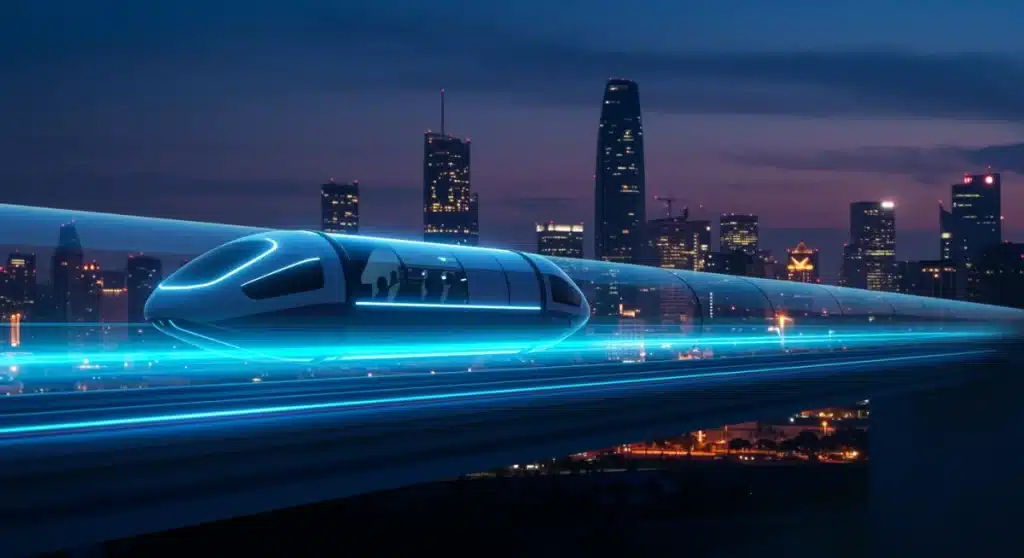
Investment in hyperloop technology is projected to surge by 30% by 2026, indicating a pivotal shift towards advanced, high-speed transportation solutions that could redefine global travel and logistics.
The landscape of global transportation is on the cusp of a profound transformation, with a notable market trend: investment in hyperloop technology surges by 30% in 2026, signaling future transport shifts. This significant financial influx is not merely a passing fad; it represents a serious commitment to developing a revolutionary mode of transit that promises unprecedented speed, efficiency, and sustainability. As we look towards the next decade, the implications of this surge extend far beyond just faster travel, touching on economic growth, urban planning, and environmental impact.
The Dawn of a New Era in Transportation
The concept of hyperloop, once confined to the realm of science fiction, is rapidly materializing into a tangible reality. This innovative system, which propels passenger and cargo pods through low-pressure tubes at speeds nearing that of sound, is attracting substantial capital. This isn’t just about moving people faster; it’s about fundamentally rethinking how we connect cities, regions, and even continents.
The initial investments have laid critical groundwork, focusing on research and development, prototype construction, and regulatory frameworks. The 30% surge anticipated by 2026 reflects growing confidence in the technology’s viability and its potential to disrupt traditional transport methods.
Key Drivers Behind the Investment Boom
Several factors are converging to fuel this remarkable investment growth. Understanding these drivers is crucial to appreciating the long-term impact of hyperloop technology.
- Technological Maturation: Early prototypes have demonstrated the feasibility of achieving ultra-high speeds, moving the concept from theoretical to practical.
- Environmental Imperative: Hyperloop systems boast a significantly lower carbon footprint compared to air travel and traditional rail, aligning with global sustainability goals.
- Economic Efficiency: Reduced travel times translate to increased productivity and economic opportunities, fostering new business models and regional development.
- Governmental Support: Many governments are recognizing the strategic importance of hyperloop, offering grants, regulatory assistance, and public-private partnership opportunities.
The confluence of these factors creates a compelling case for investors, who see hyperloop not just as a futuristic idea, but as a robust, scalable solution to pressing transportation challenges. This sustained interest is propelling the technology forward at an accelerated pace, promising a truly connected future.
Technological Advancements Paving the Way
The rapid acceleration of investment in hyperloop technology is inextricably linked to significant technological breakthroughs. These advancements are addressing critical engineering challenges and enhancing the system’s overall efficiency and safety, making it a more attractive proposition for both public and private sectors.
From advanced magnetic levitation systems to highly efficient vacuum pumps and sophisticated control software, each component is being refined to optimize performance. These innovations are not just incremental; they represent fundamental shifts in how high-speed transport can be achieved reliably and safely.
Innovations in Propulsion and Levitation
At the heart of hyperloop’s promise are its propulsion and levitation systems. Current research and development are pushing the boundaries of what’s possible.
- Electromagnetic Propulsion: Magnets are used to accelerate and decelerate the pods, offering smooth, rapid transitions without direct contact, minimizing friction and wear.
- Passive Magnetic Levitation: This system uses permanent magnets in the pods and conductive tracks, eliminating the need for complex, energy-intensive active levitation, reducing operational costs.
- Active Magnetic Levitation: While more complex, active systems offer precise control over levitation and stability, particularly at very high speeds, ensuring passenger comfort and safety.
These sophisticated systems are crucial for maintaining the high speeds and low energy consumption that define hyperloop. The continuous evolution in these areas directly contributes to the increasing investor confidence.
Beyond the core mechanics, advancements in materials science are also playing a vital role. Lighter, stronger composites are being developed for pod construction, improving energy efficiency and structural integrity. Furthermore, the integration of artificial intelligence and machine learning is optimizing route planning, predictive maintenance, and real-time operational adjustments, ensuring maximum efficiency and safety across the network.
Economic Impact and Investment Opportunities
The surge in hyperloop investment signals a burgeoning economic sector with vast potential for job creation, infrastructure development, and new market opportunities. This isn’t just about building tracks and pods; it’s about establishing a whole new ecosystem of services and industries.
Economists predict substantial multiplier effects, with investments in hyperloop stimulating growth in manufacturing, engineering, software development, and construction. The long-term economic benefits could rival those seen with the advent of the interstate highway system or commercial aviation.

Emerging Investment Sectors
The investment landscape around hyperloop is diverse, offering opportunities across various sectors.
- Infrastructure Development: Companies specializing in tunnel boring, vacuum tube construction, and station design are seeing increased demand.
- Component Manufacturing: Suppliers of specialized parts, from magnetic coils to advanced sensor systems and composite materials, are poised for significant growth.
- Software and AI: Development of sophisticated control systems, cybersecurity protocols, and predictive analytics for operational efficiency and safety is critical.
- Energy Solutions: Companies focused on renewable energy integration and efficient power distribution for hyperloop networks will play a crucial role in its sustainable operation.
Beyond direct investment, the promise of reduced travel times and increased connectivity can unlock new regional economies. Remote areas could become more accessible, fostering decentralization and reducing urban congestion. This economic ripple effect makes hyperloop an attractive long-term investment, moving beyond initial development costs to sustainable operational models.
Global Race: Key Players and Projects
The hyperloop revolution is a global phenomenon, with multiple companies and consortia vying to be the first to establish commercially viable routes. This competitive landscape is driving innovation and accelerating the pace of development, transforming ambitious visions into concrete projects.
From North America to Europe and Asia, governments and private entities are investing heavily in research, testing, and potential route planning. This global race is healthy, encouraging diverse approaches and fostering a rapid learning curve for the nascent industry.
Leading Hyperloop Initiatives Worldwide
Several prominent players are at the forefront of hyperloop development, each with unique strategies and technological focuses.
- Virgin Hyperloop One: A pioneer in the field, Virgin Hyperloop One has conducted numerous tests and is actively exploring routes in the United States, India, and the UAE, focusing on both passenger and cargo transport.
- Hyperloop Transportation Technologies (HTT): HTT is developing a passive magnetic levitation system and has signed agreements for feasibility studies and test tracks in several countries, including France and China.
- TransPod: Based in Canada and France, TransPod is working on an ultra-high-speed ground transportation system that uses electromagnetism and evacuated tubes, with plans for routes in Europe.
These companies, alongside numerous startups and academic institutions, are pushing the boundaries of engineering and design. The competitive drive ensures that challenges are addressed swiftly and that the most efficient and safest technologies emerge. This global collaboration and competition are crucial for hyperloop’s eventual widespread adoption.
Challenges and Regulatory Hurdles
Despite the optimistic investment forecasts and technological strides, the path to widespread hyperloop adoption is not without its obstacles. Significant challenges remain, particularly in the areas of regulatory approval, public acceptance, and the sheer scale of infrastructure development required.
Addressing these hurdles effectively will be critical for hyperloop to move from pilot projects to a fully integrated global transportation network. Navigating complex legal frameworks and ensuring public trust are as important as the engineering feats themselves.
Overcoming Key Obstacles
The successful deployment of hyperloop technology depends on tackling a range of intricate issues.
- Regulatory Frameworks: Existing transportation regulations were not designed for systems operating at near-supersonic speeds in a vacuum. New, comprehensive standards for safety, operations, and environmental impact are urgently needed.
- Land Acquisition and Rights-of-Way: Building vast networks of tubes requires significant land, often traversing diverse terrains and jurisdictions, posing complex legal and logistical challenges.
- Funding and Scalability: While initial investments are strong, the enormous capital required for large-scale deployment necessitates sustained public and private funding, along with robust financial models.
- Public Perception and Acceptance: Educating the public about the safety, benefits, and environmental advantages of hyperloop is crucial to garnering support and overcoming skepticism.
The industry is actively engaging with governments and international bodies to develop appropriate regulatory frameworks and foster public understanding. Collaborative efforts between developers, policymakers, and communities will be essential to smooth the transition and ensure hyperloop networks are built responsibly and efficiently.
The Future Outlook: Redefining Mobility
The projected 30% surge in hyperloop investment by 2026 is more than just a financial metric; it’s a strong indicator of a future where transportation is dramatically redefined. This technology promises to shrink distances, connect disparate regions, and offer an environmentally conscious alternative to current modes of travel.
Looking ahead, hyperloop could fundamentally alter urban planning, economic development, and even our daily lives. The vision is one of seamless, rapid transit that makes long-distance travel as routine as a local commute, fostering a more interconnected and efficient world.
Anticipated Transformations
- Urban Decentralization: High-speed connections could enable people to live further from major city centers, reducing urban sprawl and congestion while enhancing quality of life.
- Supply Chain Optimization: Rapid cargo transport via hyperloop could revolutionize logistics, enabling just-in-time delivery over vast distances, improving efficiency and reducing costs.
- Reduced Environmental Impact: As hyperloop networks expand, they offer a viable, low-carbon alternative to short-haul flights and long-distance road transport, contributing significantly to climate goals.
- New Economic Corridors: The creation of hyperloop routes will inevitably foster new economic development zones, attracting businesses and talent to previously underserved areas.
The journey to a fully hyperloop-integrated world will be incremental, but the current investment trend suggests we are on a clear trajectory towards this transformative future. The implications for mobility, commerce, and society as a whole are truly revolutionary, promising a new era of connectivity and sustainability.
| Key Aspect | Brief Description |
|---|---|
| Investment Surge | Hyperloop investment projected to increase by 30% by 2026, indicating strong market confidence. |
| Technological Readiness | Advancements in propulsion, levitation, and AI are making hyperloop a viable transport solution. |
| Economic Impact | Expected to create jobs, stimulate regional economies, and optimize global logistics. |
| Challenges Ahead | Regulatory hurdles, land acquisition, and public acceptance remain key obstacles for widespread adoption. |
Frequently Asked Questions About Hyperloop Investment
Investment is surging due to significant technological advancements, increased focus on sustainable transportation, and growing confidence in hyperloop’s economic viability. Prototypes have demonstrated feasibility, attracting more capital and government support for future development.
Hyperloop offers ultra-high-speed travel, significantly reduced travel times, and a lower carbon footprint compared to traditional transport. It promises to boost economic productivity, create new job markets, and improve connectivity between distant regions, redefining logistics.
North America, Europe, and Asia are currently at the forefront of hyperloop development. Companies like Virgin Hyperloop One, HTT, and TransPod are actively pursuing projects, feasibility studies, and test tracks in various countries, driving global competition and innovation.
Key challenges include developing new regulatory frameworks for safety, securing vast land for infrastructure, ensuring sustained funding for large-scale deployment, and gaining public acceptance. Overcoming these hurdles is crucial for successful integration into global transport systems.
Hyperloop could enable urban decentralization by making remote living more feasible. It will revolutionize logistics through rapid cargo transport, optimizing supply chains and reducing delivery times. This fosters new economic corridors and reduces urban congestion significantly.
Conclusion
The unmistakable surge in hyperloop investment by 30% by 2026 underscores a pivotal moment in the evolution of global transportation. This financial commitment signals far more than just technological curiosity; it represents a serious, concerted effort to bring a revolutionary mode of transit to fruition. As the world grapples with the demands for faster, more efficient, and environmentally sustainable travel, hyperloop technology stands poised to deliver. While significant challenges remain in regulation, infrastructure, and public acceptance, the current trajectory suggests a future where our understanding of distance and connectivity is fundamentally transformed, ushering in an exciting new era for mobility and commerce across the globe.