Hyperloop Technology’s 2026 Impact on U.S. Freight Transport
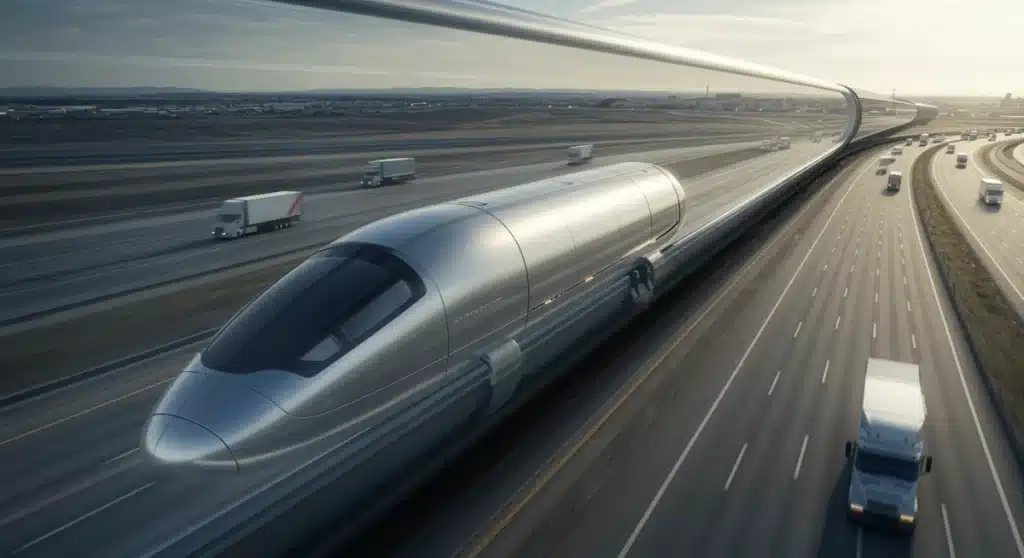
By 2026, hyperloop freight transport is anticipated to significantly reshape U.S. logistics, offering high-speed, sustainable, and efficient movement of goods across vast distances.
Imagine a future where goods traverse the vast expanse of the United States not by road, rail, or air, but through a network of vacuum-sealed tubes, propelled at speeds previously unimaginable for cargo. This isn’t science fiction; it’s the burgeoning reality of hyperloop freight transport, a revolutionary concept poised to redefine logistics. By 2026, the foundational elements for this transformative technology are expected to be firmly in place, offering a compelling vision for how American commerce will move.
Understanding Hyperloop Technology and Its Core Principles
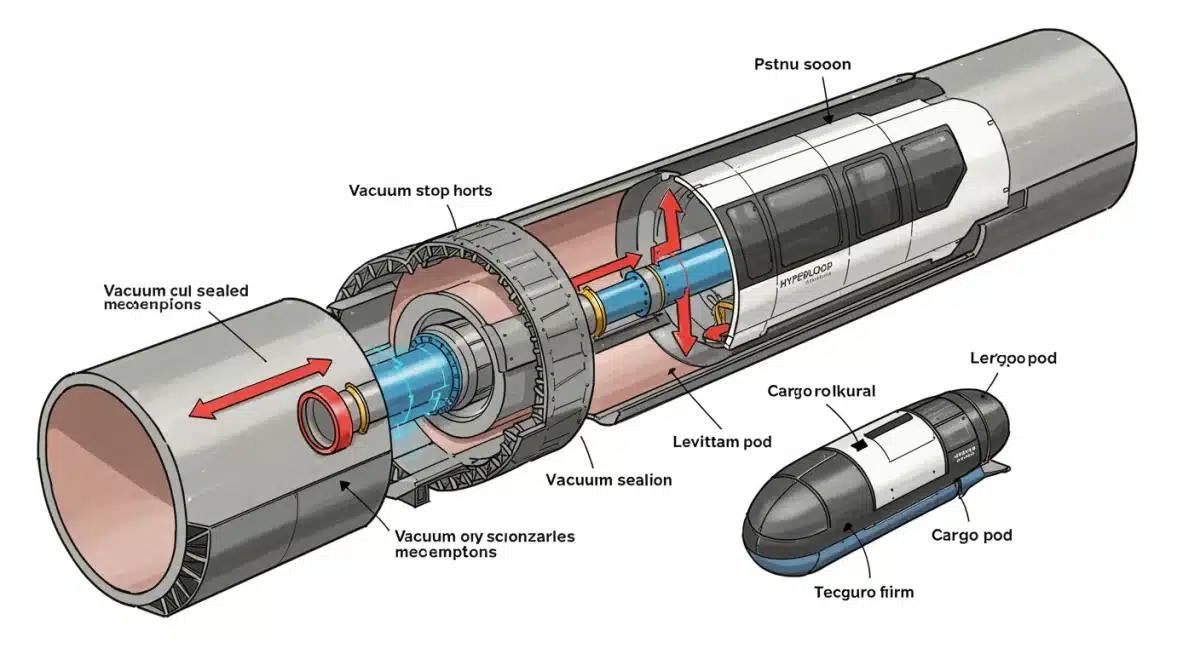
Hyperloop technology represents a paradigm shift in transportation, moving beyond conventional methods to offer a fundamentally different approach to moving people and goods. At its core, the system involves specialized pods or capsules traveling at extremely high speeds within a near-vacuum tube. This environment drastically reduces air resistance, the primary impediment to high-speed travel, allowing for unparalleled velocity and efficiency.
The principles behind hyperloop are rooted in electromagnetism and low-pressure environments. By evacuating most of the air from the tube, drag is minimized, enabling pods to glide with minimal friction. Magnetic levitation (maglev) further enhances this by lifting the pods above the track, eliminating wheel-on-rail friction and allowing for smooth, ultra-fast movement. This combination of vacuum and maglev is what grants hyperloop its unique capabilities, distinguishing it from all existing transport modes.
Key Technological Components
- Vacuum Tubes: These are the arteries of the hyperloop system, depressurized to create a near-vacuum, dramatically reducing air resistance.
- Magnetic Levitation: Electromagnets lift and guide the pods, eliminating friction and enabling smooth, high-speed travel.
- Propulsion System: Linear induction motors, similar to those used in maglev trains, accelerate and decelerate the pods.
- Cargo Pods: Specially designed capsules capable of carrying various types of freight, optimized for aerodynamics and payload capacity within the tube.
The technological sophistication of hyperloop is not just about speed; it’s about creating an entirely new ecosystem for logistics. From advanced sensor networks that monitor tube conditions to sophisticated control systems that manage pod movements and scheduling, every aspect is designed for precision and reliability. The integration of artificial intelligence for route optimization and predictive maintenance will further enhance its operational efficiency, making it a truly smart transportation system.
In essence, hyperloop is not merely a faster train; it’s a completely enclosed, weather-independent, and highly automated transport network. This inherent resilience to external factors ensures consistent performance, a critical advantage for time-sensitive freight. The foundational understanding of these principles is crucial to grasping its potential impact on U.S. freight transport.
The Economic Imperative: Why U.S. Freight Needs a Hyperloop Solution
The current U.S. freight transport landscape, while robust in many ways, faces significant challenges that hyperloop technology could directly address. Congestion on highways, aging railway infrastructure, and the environmental impact of traditional methods are pressing issues. These problems translate into higher operational costs, longer transit times, and increased carbon emissions, all of which hinder economic growth and sustainability efforts.
Consider the sheer volume of goods moved across the U.S. daily. Trucks carry the majority of this freight, contributing to traffic bottlenecks and wear and tear on roads. Rail is efficient for bulk goods over long distances but lacks the speed and flexibility for time-critical deliveries. Air freight is fast but prohibitively expensive and environmentally intensive for many applications. This fragmented system creates inefficiencies that cost businesses billions annually.
Addressing Current Logistical Bottlenecks
- Traffic Congestion: Hyperloop could alleviate road congestion by shifting a significant portion of long-haul freight off highways.
- Transit Time Reduction: Goods could travel from coast to coast in hours, not days, revolutionizing supply chain management.
- Operational Costs: While initial investment is high, the long-term operational costs due to reduced fuel consumption and maintenance could be lower.
- Environmental Impact: A fully electric, vacuum-sealed system offers a zero-emission alternative to fossil fuel-dependent transport.
The economic imperative for hyperloop in U.S. freight transport is clear. Businesses are constantly seeking ways to optimize their supply chains, reduce lead times, and lower their carbon footprint. Hyperloop offers a compelling solution that directly responds to these demands. It promises faster inventory turnover, enabling companies to adopt lean manufacturing principles more effectively and respond to market changes with unprecedented agility.
Furthermore, the ability to deliver goods rapidly and reliably could unlock new economic opportunities for regions currently underserved by efficient transport links. It could foster regional specialization and create new distribution hubs, stimulating economic development across the country. The long-term economic benefits, including job creation in construction, maintenance, and operations, are substantial, making hyperloop a strategic investment in the nation’s future infrastructure.
2026 Outlook: Pilot Projects and Early Adopters in the U.S.
By 2026, while a nationwide hyperloop network for freight might still be a vision, significant strides are expected to be made in the form of pilot projects and early commercial deployments within the U.S. These initial phases are crucial for validating the technology at scale, demonstrating its reliability, and proving its economic viability. Several companies and consortia are actively pursuing these goals, focusing on specific high-value corridors.
Expect to see dedicated test tracks and short operational segments designed to transport specific types of freight. These could include high-value, time-sensitive goods like pharmaceuticals, fresh produce, or e-commerce parcels, where the benefits of speed and efficiency are most pronounced. Early adopters will likely be large logistics companies or retailers looking to gain a competitive edge and optimize their supply chains.
Anticipated Developments by 2026
- Increased Testing: More extensive and higher-speed testing of cargo pods within operational-scale tubes.
- Regulatory Framework: Development of initial safety regulations and operational standards specifically for hyperloop freight.
- Strategic Partnerships: Formation of strong alliances between tech companies, logistics providers, and government agencies.
- Demonstration Routes: Establishment of short, dedicated routes connecting key industrial or distribution centers, proving concept.
These early projects will provide invaluable data on operational costs, energy consumption, and environmental performance. They will also serve as vital showcases, building public and investor confidence in the technology. The regulatory environment will also begin to take shape, moving from conceptual discussions to concrete guidelines for construction, safety, and operation, essential for widespread adoption.
The focus during this period will be on perfecting the technology, refining operational procedures, and demonstrating a clear return on investment for early adopters. While these initial segments may seem small in the grand scheme, they represent the critical first steps towards a fully integrated hyperloop freight network across the U.S. The lessons learned from these pilots will inform the design and deployment of future, larger-scale projects.
Challenges and Hurdles: Navigating the Path to Widespread Adoption
Despite its immense promise, the path to widespread adoption of hyperloop technology for U.S. freight transport is fraught with significant challenges. These hurdles are not insurmountable but require concerted effort, innovation, and strategic planning from all stakeholders. Understanding these obstacles is key to appreciating the complexity of bringing such a revolutionary system to fruition.
One of the most prominent challenges is the sheer upfront capital investment required for infrastructure. Building miles of vacuum-sealed tubes, propulsion systems, and terminals demands astronomical sums. Securing this funding, whether through public-private partnerships or private investment, remains a major hurdle. Additionally, the regulatory environment for such a novel technology is still evolving, creating uncertainty for developers and investors.
Major Obstacles to Overcome
- Capital Investment: The enormous cost of building hyperloop infrastructure requires innovative financing models.
- Regulatory Framework: Establishing comprehensive safety standards and operational guidelines for a new mode of transport.
- Land Acquisition: Securing rights-of-way for thousands of miles of tubes across diverse terrains and private properties.
- Public Acceptance: Gaining community support and addressing concerns about noise, visual impact, and safety.
Beyond financial and regulatory concerns, technical challenges also persist. While prototypes have demonstrated high speeds, scaling these systems to operate reliably and safely across vast distances, through varying climates and terrains, presents complex engineering problems. Ensuring the integrity of the vacuum, preventing seismic damage, and developing fail-safe mechanisms for emergencies are critical considerations.
Moreover, integrating hyperloop into existing logistics networks will require careful planning. How will goods seamlessly transfer from trucks or trains to hyperloop pods and back again? The development of efficient intermodal hubs is essential to realize the full potential of this technology. Addressing these multifaceted challenges will require a collaborative approach involving governments, industry, and academia, ensuring that hyperloop’s promise is realized responsibly and effectively.
Environmental and Sustainability Advantages of Hyperloop Freight
The environmental impact of traditional freight transport methods is a growing concern, with increasing pressure on industries to adopt more sustainable practices. This is where hyperloop technology offers a compelling solution, positioning itself as a potentially game-changing innovation for reducing the carbon footprint of U.S. logistics. Its inherent design principles lend themselves to significant environmental benefits.
Unlike diesel-powered trucks or even electric trains that still rely on energy generated from various sources, a hyperloop system can be designed to be entirely electric and powered by renewable energy sources. Imagine solar panels lining the hyperloop tubes, generating the electricity needed to propel the pods. This vision of a truly green freight network is a powerful motivator for its development.
Eco-Friendly Benefits
- Zero Direct Emissions: As an electric system, hyperloop produces no tailpipe emissions during operation.
- Reduced Energy Consumption: The near-vacuum environment drastically cuts energy needed for propulsion compared to air or road transport.
- Minimized Land Footprint: Hyperloop tubes can be elevated or underground, reducing disruption to ecosystems and existing land use.
- Noise Pollution Reduction: Operating within sealed tubes, hyperloop generates significantly less noise than traditional transport.
The energy efficiency of hyperloop is a key advantage. By eliminating air resistance and friction, the amount of energy required to move a given payload at high speeds is substantially less than current methods. This translates not only to lower operational costs but also to a reduced overall energy demand, which can be more easily met by renewable sources like solar and wind power.
Furthermore, the environmental benefits extend beyond emissions. By reducing the number of heavy trucks on the road, hyperloop could decrease road maintenance needs, alleviate traffic congestion, and reduce the likelihood of accidents, all of which have indirect environmental and social costs. The strategic deployment of hyperloop could therefore contribute significantly to national sustainability goals, aligning with a broader movement towards a greener economy and future logistics.
Integrating Hyperloop into the Existing U.S. Logistics Network
For hyperloop to truly transform U.S. freight transport, it cannot exist in isolation. Its success hinges on seamless integration into the nation’s vast and complex existing logistics network. This involves creating efficient interfaces with current modes of transport, including trucking, rail, and air freight, to ensure a smooth flow of goods from origin to destination.
The vision is not to replace all existing transport methods but to complement them, filling critical gaps and offering a high-speed backbone for the movement of specific types of freight. This will necessitate the development of specialized intermodal hubs where cargo can be quickly and efficiently transferred between hyperloop pods and other vehicles. These hubs will be crucial connection points, acting as nerve centers for the new logistics paradigm.
Seamless Integration Strategies
- Intermodal Hubs: Designing and building facilities for rapid transfer between hyperloop and other transport modes.
- Standardized Cargo Units: Developing compatible freight containers that can be easily loaded onto hyperloop pods, trucks, and trains.
- Digital Logistics Platforms: Integrating hyperloop scheduling and tracking into existing supply chain management software.
- Last-Mile Solutions: Collaborating with local logistics providers for efficient delivery from hyperloop terminals to final destinations.
The integration strategy will require a high degree of standardization and interoperability. Freight containers will need to be designed to fit both hyperloop pods and conventional trucks or railcars. Digital platforms will play a pivotal role, providing real-time tracking, optimized routing, and predictive analytics across the entire multimodal journey. This level of coordination will ensure that the speed advantage of hyperloop is not lost during transfers.
Ultimately, a successful integration will mean that hyperloop becomes an intrinsic part of a smarter, more efficient, and more sustainable U.S. logistics ecosystem. It will enable a tiered approach to freight movement, where hyperloop handles the high-speed, long-distance segments, while existing modes manage collection and distribution. This collaborative model promises to unlock unprecedented efficiencies and deliver a truly transformed freight transport landscape by 2026 and beyond.
The Societal Impact: Beyond Just Moving Goods Faster
The rise of hyperloop technology for U.S. freight transport extends far beyond merely accelerating the movement of goods. Its societal impact could be profound, reshaping urban development, influencing employment patterns, and even affecting the cost of living. This revolutionary infrastructure has the potential to touch nearly every aspect of American life, creating both opportunities and new considerations.
One significant impact could be on regional development. With hyperloop, remote areas could become more viable for manufacturing and distribution, as their connection to major markets would be dramatically improved. This decentralization could lead to new economic hubs, reducing pressure on overcrowded urban centers and fostering more balanced growth across the country. It could also open up new job markets in areas that previously lacked efficient logistical links.
Broader Societal Implications
- Regional Economic Growth: Enhanced connectivity could spur development in previously underserved areas.
- Reduced Road Wear and Tear: Less heavy truck traffic could extend the lifespan of roads, reducing maintenance costs for taxpayers.
- Improved Air Quality: A shift from fossil-fuel-intensive transport could lead to cleaner air in urban and suburban areas.
- Job Creation: New jobs in construction, engineering, operations, and maintenance of hyperloop systems.
The environmental benefits, as previously discussed, also translate directly into societal gains. Cleaner air, reduced noise pollution, and a smaller carbon footprint contribute to a healthier and more sustainable environment for all citizens. Furthermore, by reducing traffic congestion, hyperloop could improve commuting times for individuals and enhance overall quality of life in densely populated regions.
However, societal shifts also bring challenges. The potential for job displacement in traditional trucking sectors, for example, will need to be addressed through retraining programs and new opportunities within the hyperloop ecosystem. Careful urban planning will be essential to manage the development of new hyperloop terminals and ensure they integrate harmoniously with existing communities. Ultimately, the successful deployment of hyperloop will require a holistic approach that considers not just technological and economic factors, but also its broader implications for society.
| Key Aspect | 2026 Outlook |
|---|---|
| Technology Readiness | Pilot projects and advanced testing demonstrating viability for specific freight types. |
| Economic Impact | Potential for reduced transit times, lower operational costs, and supply chain optimization. |
| Environmental Benefits | Zero direct emissions and high energy efficiency for sustainable freight movement. |
| Integration Challenges | High upfront costs, regulatory hurdles, and need for seamless intermodal connectivity. |
Frequently Asked Questions About Hyperloop Freight
Hyperloop freight transport involves moving goods at very high speeds through low-pressure tubes using magnetic levitation. This system aims to significantly reduce air resistance and friction, enabling faster and more energy-efficient delivery compared to traditional methods like trucking or rail.
Hyperloop freight pods are designed to travel at speeds exceeding 600 miles per hour (around 960 km/h), potentially reaching speeds up to 760 mph. These speeds could drastically cut down shipping times across the U.S., making coast-to-coast delivery possible in just a few hours.
Hyperloop freight is ideally suited for high-value, time-sensitive goods such as pharmaceuticals, fresh produce, e-commerce packages, and medical supplies. Its speed and reliability make it perfect for supply chains where rapid delivery and minimal transit times are critical factors for success.
Hyperloop freight offers substantial environmental benefits, including zero direct emissions during operation as it’s an electric system. Its low-pressure environment also means significantly reduced energy consumption compared to conventional transport, making it a highly sustainable option when powered by renewable energy.
By 2026, the U.S. is anticipated to see the emergence of pilot projects and short, dedicated operational segments for hyperloop freight transport. Widespread commercial deployment across extensive networks is expected to take longer, likely in the 2030s, as technology matures and regulatory frameworks are established.
Conclusion
The 2026 outlook for hyperloop freight transport in the U.S. paints a picture of nascent but rapidly advancing innovation. While a full-scale national network remains a longer-term aspiration, the coming years are critical for establishing foundational pilot projects and proving the technology’s immense potential. Hyperloop promises not just faster delivery, but a complete re-imagining of logistics, offering unparalleled efficiency, significant environmental advantages, and a catalyst for economic development. Overcoming the substantial financial, regulatory, and integration challenges will be key, but the transformative benefits for American commerce and society make it a future worth pursuing.