EV Battery Innovations 2026: Double Range, US Logistics Impact
The 3 Latest EV Battery Innovations Set to Double Range by 2026: An Insider’s Look for US Logistics (RECENT UPDATES)
The landscape of electric vehicles (EVs) is on the cusp of a monumental transformation, driven by relentless innovation in battery technology. For the US logistics sector, this isn’t just an interesting development; it’s a game-changer that promises to redefine operational efficiency, reduce costs, and accelerate the transition to sustainable freight transport. The promise of doubling EV range by 2026 is no longer a distant dream but a tangible reality, thanks to three groundbreaking EV battery innovations that are rapidly moving from laboratory breakthroughs to commercial deployment.
Imagine electric semi-trucks traversing vast distances across the United States on a single charge, delivery vans operating for entire shifts without needing a top-up, and cold chain logistics maintaining optimal temperatures for longer, all powered by more efficient, safer, and faster-charging batteries. This isn’t science fiction; it’s the imminent future shaped by these remarkable advancements. Understanding these EV battery innovations is crucial for any logistics professional looking to future-proof their operations and capitalize on the coming electric revolution.
This comprehensive guide will delve deep into the three most impactful EV battery innovations: solid-state batteries, silicon anode technology, and structural batteries. We will explore the science behind them, their current development status, and, most importantly, their projected impact on range, charging times, safety, and cost. Furthermore, we will analyze the specific implications for US logistics, from long-haul trucking to last-mile delivery, offering an insider’s perspective on how these technologies will reshape the industry and provide a significant competitive advantage to early adopters.
The Urgent Need for Enhanced EV Battery Performance in Logistics
Before we dive into the specifics of these EV battery innovations, it’s essential to understand why this quest for enhanced performance is so critical, especially for the logistics sector. Current EV battery technology, while impressive, still presents certain limitations that hinder widespread adoption in heavy-duty applications:
- Range Anxiety: For long-haul trucking, the limited range of current electric trucks necessitates frequent, time-consuming charging stops, impacting delivery schedules and overall efficiency. Doubling the range can effectively eliminate this anxiety for many routes.
- Payload Capacity: The weight and volume of current battery packs can reduce the available payload capacity of electric trucks, directly affecting profitability. Lighter, more compact batteries are a significant advantage.
- Charging Infrastructure & Time: While charging infrastructure is expanding, the time required to fully charge large battery packs remains a bottleneck. Faster charging capabilities are paramount for quick turnarounds.
- Cost: The initial capital expenditure for electric fleets, largely driven by battery costs, is a significant barrier. Innovations that reduce battery cost per kWh or extend battery life will accelerate adoption.
- Safety & Durability: Logistics vehicles operate in demanding environments. Batteries need to be robust, safe, and capable of withstanding various operational stresses.
Addressing these challenges is precisely what the upcoming EV battery innovations aim to do. By 2026, the advancements discussed here are projected to offer solutions that not only mitigate these issues but transform them into competitive strengths for businesses leveraging electric vehicles.
1. Solid-State Batteries: The Holy Grail of Energy Storage
Perhaps the most anticipated of all EV battery innovations, solid-state batteries (SSBs) are often referred to as the ‘holy grail’ of energy storage. Unlike traditional lithium-ion batteries that use a liquid electrolyte, SSBs replace this volatile component with a solid material. This seemingly simple change unlocks a cascade of benefits that are particularly attractive for the logistics industry.
The Science Behind Solid-State Batteries
In a conventional lithium-ion battery, lithium ions move between the anode and cathode through a liquid electrolyte. This liquid is flammable and can degrade over time, leading to safety concerns and reduced battery life. Solid-state batteries, however, use a solid electrolyte – typically a ceramic, glass, or polymer composite. This solid medium facilitates ion transfer but eliminates the risk of leakage and significantly reduces the chance of thermal runaway, a precursor to battery fires.
The solid electrolyte also allows for the use of a lithium metal anode, which has a much higher energy density than the graphite anodes used in current lithium-ion batteries. This is key to achieving significantly higher energy densities, meaning more power in a smaller, lighter package.
Current Status and Projected Impact by 2026
Major players like Toyota, QuantumScape, Solid Power, and Samsung are heavily invested in solid-state battery development, with significant progress reported. While full-scale commercialization for EVs is still a few years away, prototypes are demonstrating impressive performance. By 2026, we can expect to see early adoption in premium or specialized electric vehicles, with wider integration in logistics fleets following shortly after.
Impact on EV Range and Performance:
- Doubled Energy Density: SSBs are projected to offer energy densities of 500 Wh/kg or even higher, compared to 250-300 Wh/kg for current Li-ion batteries. This directly translates to double the range for a battery of the same size and weight, or the same range with a much smaller and lighter battery.
- Faster Charging: The solid electrolyte can enable faster ion transfer, potentially allowing for ultra-fast charging times – perhaps an 80% charge in 10-15 minutes, which is crucial for minimizing downtime in logistics operations.
- Enhanced Safety: The elimination of flammable liquid electrolytes drastically reduces the risk of fires, making SSBs inherently safer for large-scale logistics applications and reducing insurance costs.
- Longer Lifespan: Solid electrolytes are more stable and less prone to degradation, potentially leading to batteries that last longer, reducing total cost of ownership for fleets.
Implications for US Logistics:
- Long-Haul Dominance: With double the range, electric semi-trucks could complete cross-state journeys without intermediate charging, making them a viable alternative to diesel for many long-haul routes.
- Increased Payload: Lighter battery packs mean more cargo can be carried, improving profitability per trip.
- Reduced Downtime: Ultra-fast charging will allow electric trucks to spend less time at charging stations and more time on the road, improving asset utilization.
- Safety & Regulatory Compliance: Enhanced safety features of SSBs could simplify regulatory approvals and reduce risks associated with transporting hazardous materials.

2. Silicon Anode Technology: Boosting Capacity in Existing Formats
While solid-state batteries represent a radical shift, silicon anode technology offers a powerful evolutionary step, significantly improving the energy density of existing lithium-ion battery architectures. This EV battery innovation focuses on replacing or augmenting the graphite in the anode with silicon.
The Promise of Silicon Anodes
Graphite anodes, the standard in today’s Li-ion batteries, can store a certain amount of lithium ions. Silicon, however, has a theoretical capacity to store up to ten times more lithium ions than graphite. By incorporating silicon into the anode, battery manufacturers can dramatically increase the energy density of the battery without a complete overhaul of the battery’s fundamental design.
The main challenge with silicon has been its tendency to expand and contract significantly during charging and discharging cycles, leading to mechanical degradation and a shorter battery lifespan. Researchers are overcoming this by developing various silicon composite materials, nanowires, and porous structures that can accommodate this volume change, making silicon anodes stable and durable.
Current Status and Projected Impact by 2026
Silicon anode technology is already seeing limited commercial deployment in some consumer electronics and high-performance EVs. Companies like Sila Nanotechnologies, StoreDot, and Group14 Technologies are leading the charge. By 2026, we expect to see widespread integration of advanced silicon anode materials in mainstream EV batteries, offering a significant boost in range and performance.
Impact on EV Range and Performance:
- 30-50% Higher Energy Density: Silicon anode batteries can offer a substantial increase in energy density compared to traditional graphite, leading to a significant boost in EV range without increasing battery pack size or weight.
- Faster Charging: Some silicon anode technologies are also being developed to support ultra-fast charging, with claims of adding hundreds of miles of range in minutes.
- Improved Power Output: Enhanced ion flow can also lead to better acceleration and overall power delivery, beneficial for heavy-duty vehicles.
- Cost-Effectiveness: As silicon is abundant, and the manufacturing processes are more aligned with existing Li-ion production, this technology can offer a more cost-effective path to higher energy density compared to entirely new battery chemistries.
Implications for US Logistics:
- Immediate Range Boost: Silicon anode batteries provide a readily implementable solution for extending the range of existing EV truck and van platforms, making them suitable for a wider array of regional and urban logistics routes.
- Seamless Integration: Because this technology is an enhancement to existing Li-ion formats, it can be integrated into current EV designs with fewer modifications, accelerating adoption.
- Competitive Advantage: Logistics companies adopting EVs with silicon anode technology will gain an immediate advantage through extended operational windows and fewer charging stops.
- Reduced Total Cost of Ownership: The combination of increased range, potentially faster charging, and a more manageable cost profile will contribute to a lower total cost of ownership for electric fleets.
3. Structural Batteries: Integrating Power and Purpose
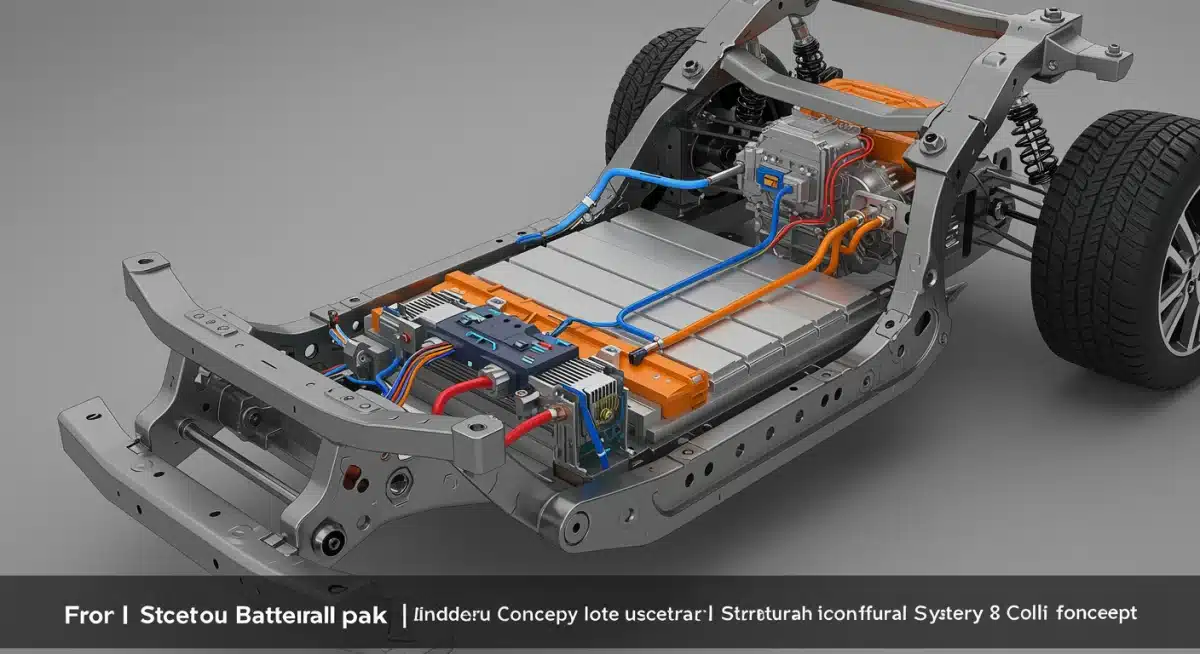
The third major EV battery innovation, structural batteries, takes a fundamentally different approach by integrating the battery’s energy storage function directly into the vehicle’s load-bearing structures. Instead of a separate, heavy battery pack, the vehicle’s chassis, body panels, or other structural components become the battery itself.
The Concept of Structural Batteries
Imagine a car’s floor, roof, or even its doors being part of the battery system. This is the essence of structural batteries. Researchers are developing composite materials that can simultaneously store electrical energy and bear mechanical loads. These composites often involve layers of carbon fiber or other strong materials interspersed with electrolyte and electrode layers. The goal is to eliminate the redundant weight and volume of separate battery enclosures and structural elements, making the vehicle lighter, more efficient, and potentially safer.
This concept is not entirely new; it has been explored in aerospace for years. However, advancements in materials science and manufacturing techniques are now making it feasible for automotive applications.
Current Status and Projected Impact by 2026
Structural battery technology is still in earlier stages of commercial readiness compared to solid-state or advanced silicon anodes, but significant breakthroughs are occurring. Companies like Volvo (through its subsidiary Polestar) and researchers at Imperial College London and Chalmers University of Technology are actively developing prototypes. By 2026, we might see initial applications in specific vehicle components or specialized EVs, with broader integration growing thereafter.
Impact on EV Range and Performance:
- Significant Weight Reduction: By making the battery part of the structure, considerable weight can be shed from the vehicle. Less weight means greater efficiency and extended range for the same amount of stored energy.
- Increased Volume Efficiency: Eliminating a separate battery pack frees up interior space for cargo or passengers, which is highly beneficial for logistics vehicles.
- Improved Safety & Crashworthiness: A distributed battery system integrated into the structure can potentially offer better crash protection, as energy is absorbed across a larger area, and the battery cells are protected by the vehicle’s strong frame.
- Enhanced Vehicle Dynamics: A lower and more distributed center of gravity can improve handling and stability, especially for larger logistics vehicles.
Implications for US Logistics:
- Optimized Cargo Space: For delivery vans and trucks, the ability to reclaim space currently occupied by bulky battery packs means more cargo volume, increasing delivery efficiency.
- Higher Payload Capacity: Reduced vehicle weight translates directly to higher legal payload limits, maximizing revenue per trip.
- Aerodynamic Design Freedom: Designers will have more flexibility to create aerodynamically optimized vehicle shapes, further improving energy efficiency and range.
- Increased Vehicle Durability: The inherent strength of structural composites, coupled with integrated power, could lead to more robust and long-lasting logistics vehicles.
Synergy and Overlap: How These Innovations Combine
It’s important to note that these EV battery innovations are not mutually exclusive. In fact, their true potential might be realized when they are combined. Imagine a structural battery utilizing silicon anode technology within its composite layers, powered by solid-state electrolyte principles. Such a synergy could lead to even more dramatic improvements in range, safety, and efficiency than any single technology could achieve on its own.
For instance, a solid-state battery with a silicon anode could be integrated into the structural components of an electric long-haul truck. This would result in an ultra-lightweight, extremely energy-dense, and inherently safe power source that also contributes to the vehicle’s structural integrity. The combined effect would be a vehicle capable of unprecedented range, minimal downtime, and maximum payload capacity, truly revolutionizing US logistics.
Challenges and the Path Forward for US Logistics
While the promise of these EV battery innovations is immense, their widespread adoption in US logistics will still face challenges:
- Cost of Adoption: New technologies often come with higher initial costs. Logistics companies will need to carefully evaluate the long-term ROI, factoring in fuel savings, reduced maintenance, and potential government incentives.
- Manufacturing Scale: Scaling up production of these advanced batteries to meet the demand of the entire logistics sector will be a massive undertaking.
- Infrastructure Development: While faster charging reduces individual charging times, the overall charging infrastructure will still need to expand significantly to support a fully electric logistics fleet.
- Standardization: As new battery chemistries emerge, there will be a need for industry-wide standards for battery modules, charging protocols, and safety regulations.
- Recycling and End-of-Life: Developing robust and sustainable recycling processes for these new battery chemistries will be crucial.
Despite these hurdles, the trajectory is clear. The economic and environmental pressures to electrify logistics are growing, and these EV battery innovations provide the technological backbone to make that transition not just feasible, but highly advantageous. Forward-thinking logistics companies should start planning now, engaging with EV manufacturers, battery developers, and infrastructure providers to understand how to best integrate these emerging technologies into their future fleets.
Conclusion: A New Era for Electric Logistics by 2026
The next few years will be transformative for electric vehicles, particularly in the logistics sector. The rapid advancements in EV battery innovations, including solid-state batteries, silicon anode technology, and structural batteries, are poised to deliver a doubling of EV range by 2026. This isn’t merely an incremental improvement; it’s a paradigm shift that will address the core limitations of current electric trucks and vans, making them competitive, if not superior, to their internal combustion engine counterparts.
For US logistics companies, this means a future where range anxiety is a relic of the past, where charging stops are dramatically shorter, where operational costs are lower, and where environmental sustainability is an inherent part of the business model. The early adopters of these technologies will gain a significant competitive edge, positioning themselves as leaders in a rapidly evolving industry.
Staying informed about these EV battery innovations and strategically planning for their integration will be key to unlocking the full potential of electric logistics. The future of freight is electric, and with these battery breakthroughs, that future is arriving faster than ever before.