Edge Computing’s Impact on U.S. Smart City Data Processing by 2026

Edge computing is fundamentally transforming data processing in U.S. smart cities by 2026, moving computation closer to data sources for enhanced real-time insights, improved efficiency, and robust security across various urban applications.
The urban landscape of the United States is undergoing a profound transformation, driven by technological innovations aimed at creating more efficient, sustainable, and livable environments. At the forefront of this evolution is the impact of edge computing on smart city data processing: a 2026 U.S. perspective (recent updates), a paradigm shift that promises to redefine how urban centers manage, analyze, and respond to the vast amounts of data generated daily. This article delves into the critical role edge computing plays in shaping the future of U.S. smart cities, exploring its benefits, challenges, and the latest advancements.
Understanding Edge Computing in the Smart City Context
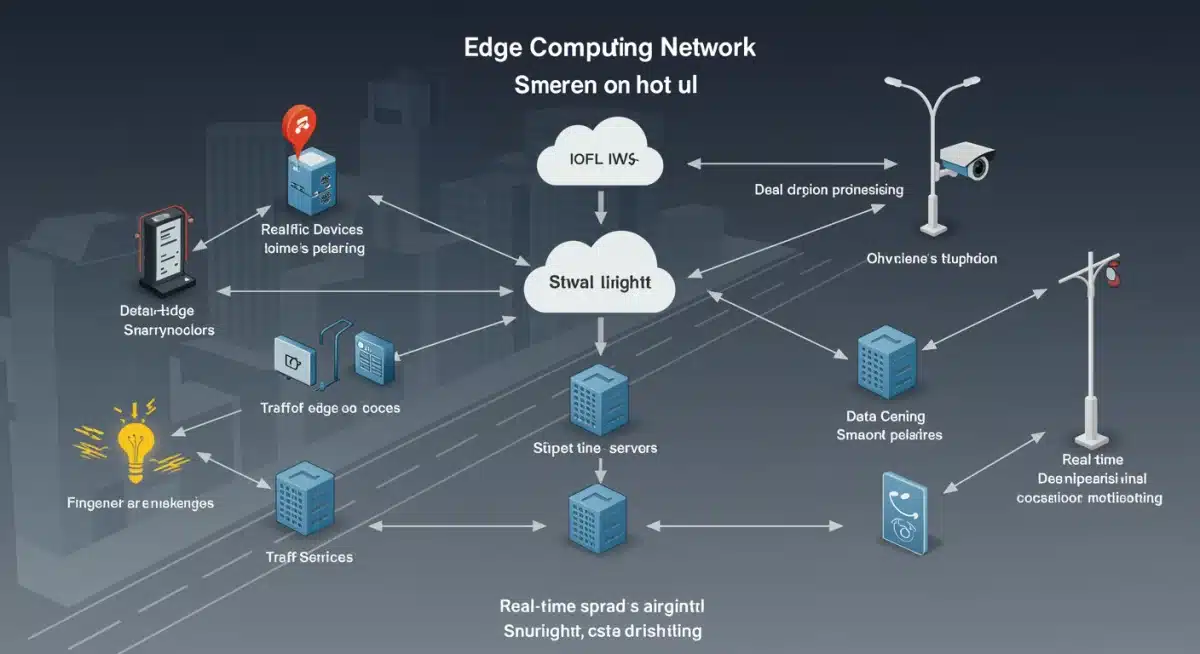
Edge computing represents a distributed computing paradigm that brings computation and data storage closer to the sources of data. In the context of smart cities, this means processing information generated by countless IoT devices—sensors, cameras, smart meters, and autonomous vehicles—at the ‘edge’ of the network, rather than sending it all to a centralized cloud server. This localized processing significantly reduces latency, conserves bandwidth, and enhances data security, all crucial factors for the real-time demands of urban infrastructure.
The proliferation of interconnected devices in smart cities generates an unprecedented volume of data. From traffic flow patterns to air quality metrics and public safety surveillance, this data requires immediate analysis to enable effective decision-making. Traditional cloud computing, while powerful, can introduce delays that are unacceptable for critical urban applications. Edge computing addresses this by providing immediate computational power where it’s needed most.
The Core Principles of Edge Computing for Urban Environments
To fully grasp its impact, it’s essential to understand the foundational principles that make edge computing so vital for smart cities. These principles directly address the unique challenges posed by urban data processing needs.
- Proximity: Data processing occurs near the data source, minimizing transmission distance and latency.
- Autonomy: Edge devices can operate independently, making real-time decisions even with intermittent cloud connectivity.
- Security: Localized processing reduces the attack surface by minimizing data transfer across wider networks.
- Efficiency: Less data is sent to the cloud, saving bandwidth and reducing operational costs.
These principles collectively enable smart cities to become more responsive and resilient. Imagine a scenario where traffic signals can adapt in milliseconds to prevent accidents, or where public safety cameras can detect unusual activity and alert authorities almost instantaneously. This level of responsiveness is precisely what edge computing facilitates.
In essence, edge computing is not merely an optimization; it is a fundamental enabler for the next generation of smart city applications. Its ability to handle data with speed and precision is transforming theoretical concepts into tangible urban solutions, paving the way for more intelligent and integrated city management systems.
Enhanced Real-Time Data Processing and Decision-Making
One of the most significant advantages of edge computing in smart cities is its capacity for enhanced real-time data processing. In urban environments, where situations can change in an instant, the ability to analyze data and make decisions without delay is paramount. Edge devices, strategically placed throughout the city, can perform immediate analytics on incoming data streams, triggering actions or providing insights far quicker than a cloud-centric model.
Consider the myriad of sensors deployed across a smart city: traffic cameras monitoring vehicle density, environmental sensors tracking air quality, and smart streetlights adjusting illumination based on ambient light and pedestrian presence. Each of these devices generates continuous streams of data. Without edge computing, sending all this raw data to a distant cloud server for processing would create significant bottlenecks, leading to unacceptable delays in response times.
Applications Benefiting from Low Latency
The low latency offered by edge computing directly translates into tangible benefits across various urban applications. These applications are critical for both the safety and efficiency of city operations.
- Intelligent Transportation Systems (ITS): Real-time traffic optimization, accident detection, and autonomous vehicle navigation rely heavily on instantaneous data processing. Edge computing allows vehicles to communicate with infrastructure and with each other in milliseconds, preventing collisions and reducing congestion.
- Public Safety and Emergency Response: Surveillance cameras equipped with edge AI can detect anomalies or suspicious activities instantly, alerting law enforcement before a situation escalates. Similarly, smart fire alarms can process sensor data locally to confirm fires and notify emergency services more rapidly.
- Utility Management: Smart grids can leverage edge computing to detect power outages, manage energy distribution, and balance loads in real-time, improving reliability and reducing waste. Water management systems can identify leaks or anomalies in water flow with similar efficiency.
Beyond these immediate applications, the real-time capabilities of edge computing also foster innovation in areas like waste management, public health monitoring, and personalized urban services. By bringing computation closer to the source, cities can move from reactive responses to proactive interventions, creating a more dynamic and responsive urban ecosystem. This shift is fundamental to achieving the vision of truly intelligent and adaptive smart cities across the U.S. by 2026.
Enhancing Security and Privacy at the Edge
As smart cities become increasingly interconnected, the sheer volume of sensitive data collected raises significant concerns regarding security and privacy. Edge computing offers a robust solution by processing data locally, thereby reducing the amount of sensitive information transmitted to centralized cloud servers. This localized processing minimizes the exposure of data to potential cyber threats and simplifies compliance with data privacy regulations.
When data is processed at the edge, only aggregated or anonymized insights, rather than raw data, may need to be sent to the cloud. This significantly shrinks the attack surface for malicious actors. Imagine surveillance footage from public cameras: instead of streaming all raw video to a data center, edge devices can process the footage to detect specific events (e.g., a fallen person, a traffic violation) and only send alerts or metadata to the central system. This approach not only protects individual privacy but also strengthens the overall security posture of the smart city infrastructure.
Key Security Advantages of Edge Deployments
The architectural benefits of edge computing naturally translate into several critical security advantages that are highly relevant for sensitive urban operations.
- Reduced Data Exposure: Less raw data transmitted across public networks means fewer opportunities for interception.
- Localized Threat Containment: A breach at one edge node is less likely to compromise the entire network, unlike a centralized cloud breach.
- Faster Incident Response: Security anomalies can be detected and addressed at the edge, often before they can propagate.
- Improved Compliance: Easier to meet local data residency and privacy regulations (e.g., GDPR-like regulations in specific U.S. states) by keeping data within defined geographical boundaries.
These advantages are particularly important in the U.S. context, where data privacy regulations are becoming increasingly stringent and public trust in data handling is paramount. By decentralizing data processing, smart cities can build more secure and privacy-respecting systems, fostering greater acceptance among citizens.
Furthermore, the distributed nature of edge computing inherently provides a layer of resilience. If one edge node fails or is compromised, other nodes can continue to operate, ensuring the continuity of essential city services. This resilience, combined with enhanced security and privacy, makes edge computing an indispensable component for the secure and trustworthy operation of future smart cities.
Cost Efficiency and Bandwidth Optimization
Beyond its performance and security benefits, edge computing also offers substantial advantages in terms of cost efficiency and bandwidth optimization for smart city deployments. The traditional model of sending all raw data from countless IoT devices to a central cloud for processing incurs significant costs related to data transmission and cloud storage. Edge computing mitigates these expenses by intelligently filtering, aggregating, and processing data locally.
By processing data at the source, edge devices can extract only the most critical information, sending much smaller, more refined data packets to the cloud. This ‘data reduction at the edge’ strategy dramatically reduces the amount of data that needs to traverse wide area networks (WANs), thereby lowering bandwidth requirements and associated communication costs. For cities managing thousands or even millions of connected devices, these savings can be monumental, making smart city initiatives more financially sustainable.
Operational Savings and Infrastructure Benefits
The financial benefits extend beyond just bandwidth. There are significant operational savings and infrastructure advantages that make edge computing an attractive option for urban planners.
- Reduced Cloud Storage Costs: Less raw data stored in the cloud directly translates to lower cloud storage fees.
- Optimized Network Infrastructure: Existing network infrastructure can be utilized more efficiently, potentially delaying costly upgrades.
- Lower Energy Consumption: Distributed processing can lead to more efficient energy use across the entire network, rather than relying solely on energy-intensive central data centers.
- Scalability: Edge deployments can be scaled incrementally, adding capacity where and when it’s needed, rather than over-provisioning centralized resources.
The cumulative effect of these efficiencies allows smart cities to deploy more IoT devices and expand their intelligent infrastructure without facing prohibitive operational costs. This economic viability is a crucial factor for the widespread adoption of smart city technologies across diverse U.S. municipalities, enabling even smaller cities to leverage advanced data processing capabilities. Ultimately, edge computing provides a pragmatic and economical pathway to building smarter, more connected urban environments.
Challenges and Considerations for U.S. Smart Cities
While the benefits of edge computing for smart cities are compelling, its implementation in the U.S. context is not without challenges. Deploying and managing a vast network of edge devices across diverse urban landscapes requires careful planning, significant investment, and overcoming various technical and regulatory hurdles. Understanding these challenges is crucial for successful integration and maximizing the potential of this technology.
One primary concern is the complexity of managing a distributed infrastructure. Unlike centralized cloud systems, edge deployments involve numerous small-scale computing units spread across a wide geographical area. This can complicate maintenance, updates, and troubleshooting. Furthermore, ensuring interoperability between different vendors’ edge hardware and software solutions presents another layer of complexity, demanding standardized protocols and open architectures.
Key Implementation Hurdles
Several specific challenges stand out when considering the widespread adoption of edge computing in U.S. smart cities.
- Infrastructure Investment: Significant upfront capital is required to deploy edge hardware, network connectivity, and specialized software. Funding models and public-private partnerships need to be robust.
- Cybersecurity at Scale: While edge computing enhances security, it also expands the attack surface by introducing more potential entry points. Securing each edge node individually and managing their collective security posture is a complex task.
- Data Governance and Regulations: Navigating the patchwork of state and federal data privacy laws (e.g., California Consumer Privacy Act, emerging AI regulations) across different U.S. cities can be challenging, requiring flexible and compliant edge solutions.
- Skilled Workforce: There’s a growing demand for IT professionals with expertise in edge computing, IoT, and cybersecurity. Cities need to invest in training and attracting talent to manage these advanced systems.
Addressing these challenges requires a multi-faceted approach involving collaboration between city governments, technology providers, and academic institutions. Developing clear regulatory frameworks, fostering public-private partnerships, and investing in workforce development will be critical to accelerate the adoption and successful implementation of edge computing solutions in U.S. smart cities by 2026. Proactive engagement with these issues will ensure a smoother transition to smarter urban infrastructures.
Future Outlook: Edge Computing’s Evolution in U.S. Smart Cities by 2026
Looking ahead to 2026, the trajectory of edge computing in U.S. smart cities points towards an increasingly integrated, intelligent, and autonomous urban environment. The foundational groundwork laid today will mature into sophisticated systems capable of handling even more complex data processing tasks, further blurring the lines between physical infrastructure and digital intelligence. This evolution will be driven by advancements in AI, 5G connectivity, and the growing demand for hyper-personalized urban services.
We can anticipate a significant increase in the deployment of AI at the edge, where machine learning models will run directly on local devices. This will enable predictive analytics for traffic management, proactive maintenance of public utilities, and advanced environmental monitoring without constant reliance on cloud resources. The synergy between edge computing and artificial intelligence will unlock new levels of efficiency and responsiveness previously unattainable.
Key Trends Shaping the Future
Several emerging trends are poised to accelerate the impact and adoption of edge computing in U.S. smart cities over the next few years.
- Hyper-converged Edge Infrastructure: Expect more integrated solutions combining compute, storage, and networking into single, compact edge units, simplifying deployment and management.
- Advanced 5G Integration: The rollout of 5G networks will provide the high-bandwidth, low-latency connectivity essential for linking edge devices and enabling more sophisticated applications across wider urban areas.
- Federated Learning at the Edge: This AI technique allows machine learning models to be trained on decentralized edge devices without centralizing raw data, further enhancing privacy and security, especially for sensitive urban data.
- Digital Twins Integration: Edge computing will feed real-time data into digital twin models of cities, creating highly accurate virtual replicas that can simulate urban scenarios, test interventions, and optimize operations before real-world deployment.
By 2026, edge computing will be less of a standalone technology and more of an invisible, indispensable layer within the smart city ecosystem. It will empower cities to adapt dynamically to changing conditions, provide citizens with more efficient and personalized services, and ultimately create more resilient and sustainable urban futures. The ongoing innovation in this space promises to keep U.S. smart cities at the forefront of global urban development.
| Key Aspect | Impact on Smart Cities by 2026 |
|---|---|
| Real-Time Processing | Enables instantaneous decisions for traffic, public safety, and emergencies, reducing latency. |
| Data Security & Privacy | Minimizes sensitive data transmission to the cloud, enhancing local protection and compliance. |
| Cost & Bandwidth Efficiency | Reduces cloud costs and network strain by processing data closer to its source. |
| Autonomous Operations | Empowers devices to act independently, improving resilience and continuous service delivery. |
Frequently Asked Questions About Edge Computing in Smart Cities
Edge computing processes data from IoT devices directly at the ‘edge’ of the network, close to where it’s generated, rather than sending it all to a central cloud. This reduces latency, saves bandwidth, and enables real-time decision-making for urban applications like traffic management and public safety.
By processing sensitive data locally, edge computing minimizes the amount of information transmitted to the cloud, reducing its exposure to cyber threats. It also allows for localized threat containment and faster incident response, enhancing overall data privacy and security for urban infrastructure.
By 2026, U.S. smart cities will benefit from enhanced real-time decision-making, improved public safety, optimized traffic flow, reduced operational costs, and greater data privacy through edge computing. It enables more responsive and sustainable urban environments.
Yes, significant challenges include high upfront infrastructure investment, managing complex distributed systems, ensuring cybersecurity across numerous nodes, navigating diverse data governance regulations, and addressing the shortage of skilled technical professionals to manage these advanced systems.
5G networks will significantly boost edge computing capabilities in smart cities by providing ultra-low latency and high-bandwidth connectivity. This enables faster communication between edge devices and the cloud, supporting more sophisticated applications like autonomous vehicles and advanced IoT deployments, further enhancing real-time urban management.
Conclusion
The journey towards fully realized smart cities in the U.S. is intricately linked with the evolution and widespread adoption of edge computing. As we approach 2026, it’s clear that this distributed processing paradigm is not just an incremental improvement but a fundamental enabler for the next generation of urban intelligence. By bringing computation closer to the source of data, edge computing addresses critical needs for real-time responsiveness, robust security, and cost efficiency, paving the way for more adaptive, sustainable, and citizen-centric urban environments. While challenges remain in infrastructure investment and regulatory navigation, the ongoing advancements in AI and 5G integration promise to solidify edge computing’s role as the backbone of future U.S. smart cities, transforming how we live, work, and interact within our urban landscapes.