AI-Powered Traffic Management: US Cities to Cut Congestion by 20% in 2025

AI-powered traffic management systems are revolutionizing urban mobility in US cities, leveraging real-time data, predictive analytics, and adaptive signal control to optimize traffic flow and significantly reduce congestion, targeting a 20% reduction by 2025.
The relentless crawl of urban traffic has long been a defining challenge for American cities, impacting productivity, air quality, and overall quality of life. However, a new era of urban mobility is dawning, with AI traffic management emerging as a powerful solution. This technology promises not just incremental improvements but a transformative shift, aiming to reduce congestion by an ambitious 20% in US cities by 2025.
The growing imperative for smart traffic solutions
Urban populations continue to swell, and with them, the number of vehicles on our roads. This escalating demand places immense pressure on existing infrastructure, leading to chronic congestion, increased travel times, and frustrated commuters. Traditional traffic management methods, often static and reactive, are simply no longer sufficient to address these complex, dynamic challenges.
The economic toll of traffic congestion is staggering. Billions of dollars are lost annually in wasted fuel, lost productivity, and delayed goods and services. Beyond the financial impact, there are significant environmental and social consequences, including elevated carbon emissions and reduced public health due to air pollution. These factors underscore the urgent need for innovative, data-driven approaches to manage the flow of vehicles.
Economic and environmental costs of congestion
Traffic congestion isn’t just an inconvenience; it’s a drain on resources. The average American commuter spends countless hours stuck in traffic each year, translating into significant economic losses. Moreover, idling vehicles pump out harmful pollutants, exacerbating climate change and contributing to respiratory illnesses in urban areas.
- Billions of dollars lost annually in productivity and fuel consumption.
- Increased carbon emissions and air pollution from idling vehicles.
- Reduced quality of life for urban residents due to extended commute times.
- Strain on emergency services due to delayed response times.
Addressing these multifaceted issues requires a paradigm shift, moving from reactive responses to proactive, intelligent systems. This is where AI steps in, offering the capacity to analyze vast datasets and make real-time decisions that optimize traffic flow in ways human operators simply cannot.
How AI is transforming traffic signal control
At the heart of modern AI traffic management lies the revolution in traffic signal control. Gone are the days of fixed-time signals that operate on rigid schedules, oblivious to the actual flow of vehicles. AI-powered systems are dynamic, adaptive, and constantly learning, responding to real-time conditions to keep traffic moving efficiently.
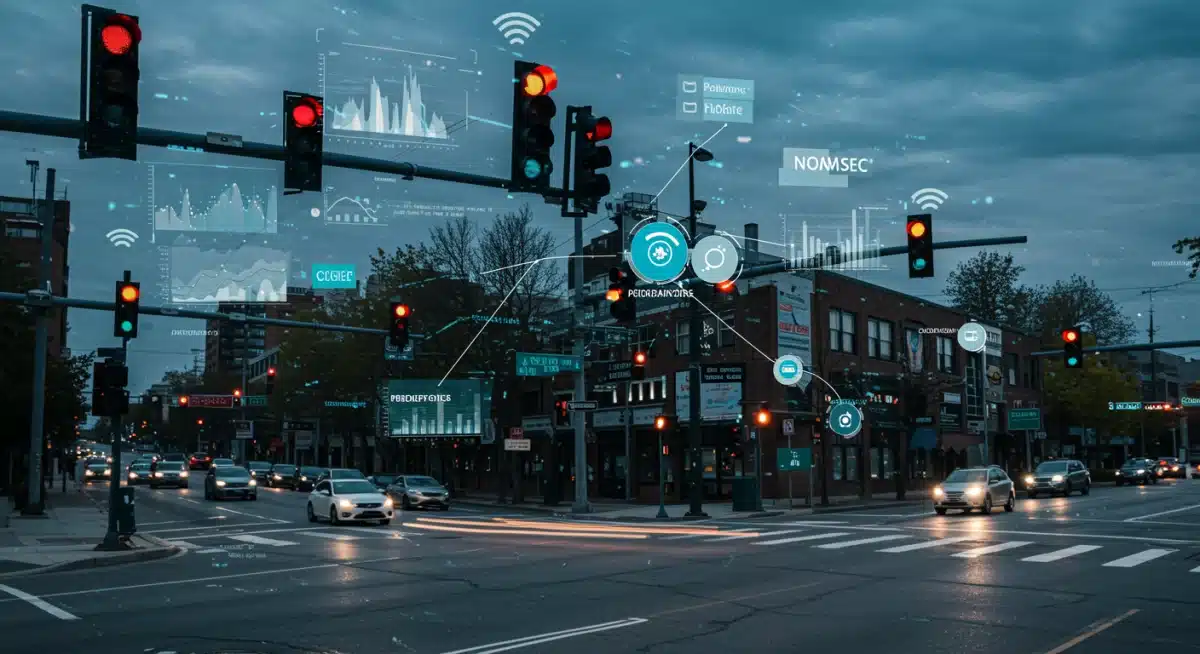
These intelligent systems integrate data from a multitude of sources, including road sensors, cameras, GPS data from connected vehicles, and even anonymized mobile phone data. This comprehensive data stream allows AI algorithms to build an accurate, up-to-the-minute picture of traffic density, speed, and patterns across an entire urban network.
Adaptive signal timing and predictive analytics
One of the most significant advancements is adaptive signal timing. AI algorithms can adjust signal phases and durations in real-time to prioritize traffic flow on congested routes, minimize waiting times at intersections, and clear bottlenecks before they fully form. This proactive approach is a game-changer for urban mobility.
- Real-time adjustment of signal phases based on current demand.
- Minimization of red-light wait times at busy intersections.
- Dynamic routing suggestions for drivers through connected apps.
- Predictive modeling to anticipate future congestion based on historical data and events.
Beyond immediate adjustments, AI also excels at predictive analytics. By analyzing historical data, weather patterns, local events, and even social media sentiment, AI can forecast potential congestion hotspots hours or even days in advance. This allows traffic managers to implement preemptive strategies, such as adjusting signal timings or deploying variable message signs, to mitigate future problems.
Leveraging real-time data for optimal urban flow
The efficacy of AI traffic management hinges on its ability to process and interpret vast quantities of real-time data. This data comes from an increasingly sophisticated array of sensors and connected technologies deployed across city infrastructures. Understanding how this data is collected and utilized is key to appreciating the power of AI in urban planning.
High-resolution cameras equipped with computer vision capabilities monitor traffic volume, vehicle types, and pedestrian activity. Inductive loops embedded in road surfaces detect vehicle presence and speed. Radar and lidar sensors provide additional layers of data, particularly in adverse weather conditions. All this information is fed into central AI platforms, creating a digital twin of the city’s traffic network.

Integration with connected and autonomous vehicles
The emergence of connected and autonomous vehicles (CAVs) represents another significant data source. CAVs can communicate with infrastructure (V2I) and with each other (V2V), providing highly granular data on their location, speed, and intended movements. This information allows AI systems to anticipate vehicle behavior and optimize traffic flow with unprecedented precision.
- Real-time vehicle location and speed data from GPS and onboard sensors.
- Communication between vehicles and infrastructure (V2I, V2V).
- Enhanced safety through early warning of hazards or congestion.
- Optimization of platooning and coordinated movements for CAVs.
The seamless integration of these diverse data streams enables AI to not only react to current congestion but also to predict and prevent it. This holistic approach ensures that traffic management is no longer a series of isolated decisions but a continuously optimizing, city-wide symphony of movement.
Pioneering US cities: case studies in AI-driven traffic reduction
Several forward-thinking US cities are already implementing advanced AI traffic management systems, serving as beacons for others aiming to achieve significant congestion reduction. Their experiences provide valuable insights into the practical application and tangible benefits of these technologies.
These pilot programs and full-scale deployments demonstrate that the 20% congestion reduction target for 2025 is not merely aspirational but achievable. By carefully analyzing their strategies and outcomes, other municipalities can learn how to tailor AI solutions to their unique urban landscapes and traffic challenges.
Success stories and ongoing initiatives
Cities like Pittsburgh, Pennsylvania, have seen remarkable results with AI-powered adaptive signal control. Their Surtrac system, developed by Carnegie Mellon University, has demonstrated significant reductions in travel times and emissions. Similarly, Los Angeles is investing heavily in AI to manage its vast and complex road network, integrating data from thousands of sensors and cameras.
- Pittsburgh’s Surtrac system reduced travel times by up to 25% and idling by 40%.
- Los Angeles’s ATSAC system continuously optimizes traffic flow across key corridors.
- Atlanta utilizes AI for incident detection and rapid response, minimizing secondary congestion.
- Gainesville, Florida, employs AI to synchronize traffic signals and improve pedestrian safety.
These examples highlight a common theme: the commitment to investing in smart infrastructure and embracing data-driven decision-making. The success of these pioneering cities provides a compelling blueprint for how other urban centers can leverage AI to create more efficient, sustainable, and livable environments.
Challenges and considerations for widespread adoption
While the promise of AI traffic management is immense, its widespread adoption across all US cities comes with a unique set of challenges. Addressing these hurdles proactively is crucial for achieving the ambitious congestion reduction targets and ensuring equitable and effective implementation.
One primary concern is the significant initial investment required for infrastructure upgrades, including the deployment of new sensors, cameras, and the sophisticated computing power needed to run AI algorithms. Many cities, especially smaller ones, may struggle to secure the necessary funding without federal or state support.
Data privacy, security, and public acceptance
Another major consideration revolves around data privacy and security. AI systems rely on collecting vast amounts of data, which raises questions about how this information is stored, processed, and protected. Ensuring public trust and addressing concerns about surveillance are paramount for successful deployment.
- High upfront costs for infrastructure and technology integration.
- Concerns regarding data privacy and the ethical use of collected information.
- The need for skilled personnel to manage and maintain complex AI systems.
- Ensuring equitable benefits across all neighborhoods, avoiding digital divides.
Furthermore, public acceptance is vital. Citizens need to understand the benefits of these systems and feel confident that their data is being used responsibly. Clear communication, transparency, and community engagement are essential to garnering support and overcoming potential resistance to new technologies that impact daily life.
The future roadmap: integrating AI with sustainable urban planning
Looking beyond 2025, the integration of AI traffic management will extend far beyond simply optimizing vehicle flow. It will become a foundational element of comprehensive sustainable urban planning, creating cities that are not only efficient but also environmentally friendly, resilient, and equitable.
The future roadmap involves a deeper convergence of AI with other smart city initiatives. This includes electric vehicle charging infrastructure, autonomous public transport networks, and integrated multimodal transportation hubs. AI will act as the central nervous system, orchestrating these diverse components into a cohesive, intelligent urban ecosystem.
AI’s role in promoting multimodal transportation
AI can play a crucial role in promoting sustainable multimodal transportation options. By analyzing commuter patterns and real-time demand, AI systems can optimize public transit routes and schedules, facilitate ride-sharing, and encourage walking and cycling through improved infrastructure and safety measures. This move away from single-occupancy vehicles is vital for long-term sustainability.
- Optimization of public transit routes and schedules based on demand.
- Seamless integration of ride-sharing and micromobility options.
- Dynamic pricing for parking and congestion zones to influence travel choices.
- Support for autonomous public transit fleets and last-mile solutions.
- Real-time information systems guiding citizens to the most efficient and sustainable travel options.
Ultimately, the goal is to create truly smart cities where AI helps residents make informed choices about their mobility, reducing their environmental footprint while enhancing their access to urban services. This vision extends to using AI for predictive maintenance of infrastructure, optimizing energy consumption, and improving emergency response, making cities safer and more resilient.
| Key Aspect | Brief Description |
|---|---|
| Adaptive Signals | AI adjusts traffic lights in real-time to optimize flow and reduce wait times. |
| Data Integration | Combines sensor, camera, and connected vehicle data for a comprehensive traffic view. |
| Predictive Analytics | Forecasts congestion to enable proactive intervention and mitigation strategies. |
| Urban Planning | AI supports multimodal transport and sustainable city development for future growth. |
Frequently asked questions about AI traffic management
AI traffic management leverages artificial intelligence, machine learning, and real-time data from various sensors to dynamically optimize traffic flow. It adjusts signal timings, reroutes vehicles, and predicts congestion to improve urban mobility and reduce delays.
By using predictive analytics and adaptive signal control, AI systems can anticipate and respond to traffic patterns more effectively than traditional methods. This real-time optimization minimizes bottlenecks, reduces idling, and streamlines movement, leading to significant congestion cuts.
AI systems integrate data from diverse sources including traffic cameras, road sensors, GPS devices, connected vehicles, and even anonymized mobile phone data. This comprehensive data stream provides a holistic view of urban traffic conditions.
Key challenges include the high initial investment in infrastructure and technology, concerns over data privacy and security, the need for skilled personnel to manage these complex systems, and ensuring equitable access and benefits across all communities.
Beyond congestion reduction, AI supports sustainable planning by optimizing public transit, encouraging multimodal transport, reducing fuel consumption and emissions, and integrating with other smart city initiatives to create more livable and environmentally friendly urban environments.
Conclusion
The journey towards a 20% reduction in urban congestion by 2025, powered by AI traffic management, is not merely an aspiration but a tangible goal within reach for US cities. Through adaptive signal control, predictive analytics, and the intelligent integration of real-time data, AI is fundamentally reshaping how urban areas manage their mobility challenges. While challenges related to investment, data privacy, and public acceptance persist, the proven benefits in pioneering cities offer a clear roadmap. The future of urban mobility is intelligent, efficient, and sustainable, with AI at its core, promising a significant improvement in the quality of life for millions of Americans.